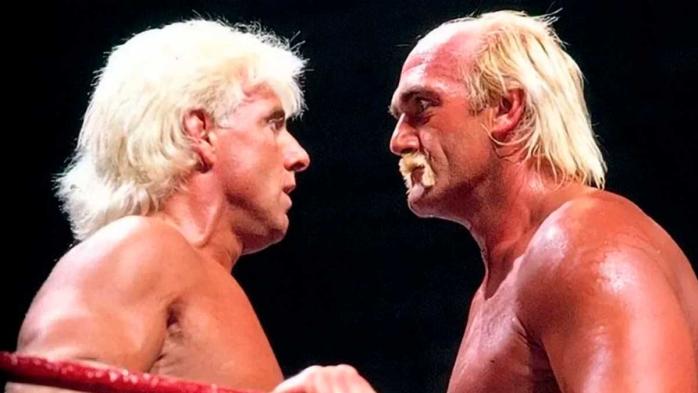

John Cena has reflected on the complicated relationship that Hulk Hogan and Ric Flair maintained with their characters throughout their careers in professional wrestling. The 17-time WWE world champion believes that both came to identify so much with their in-ring personas that they ended up losing part of the separation between their personal lives and their public personas.
During a recent interview on the What Now? with Trevor Noah podcast, Cena analyzed how the industry operated during the peak popularity years of Hogan and Flair, noting that the demands of the business and the need to maintain the illusion that wrestling was real deeply influenced their personalities.
During the conversation, Trevor Noah asked John Cena if figures like Hulk Hogan and Ric Flair had changed over the years or if, on the contrary, the public had ended up misinterpreting their personalities.
Cena rejected the idea of a simple answer and explained that it is necessary to understand the historical context in which both developed their careers.
I think it's more complex than that. They were artists of an era when wrestling was sold as if it were real, as if they were authentic fights. That's why the people who portrayed those characters had much less time to distance themselves from them.
The former world champion recalled that for much of the 20th century, wrestlers had to protect the kayfabe, the concept used in wrestling to maintain the appearance that rivalries and characters were real.
This need to constantly remain in character could make it difficult to separate the wrestler from the person behind it, especially when it came to big stars recognized by millions of fans.
Cena also recalled the harsh working conditions that wrestlers faced during WWE's national and international expansion under Vince McMahon's direction in the eighties.
He explained that the stars of that era had to face extremely demanding schedules, with very few days off and almost constant promotional activities.
We must remember that during the globalization of wrestling, when Vince McMahon took control in the early eighties, the schedule was exhausting. I'm talking about 30 days working and seven days off. Thirty days working, seven days off, or even less.
The wrestler added that professional obligations did not end when a show was over. The performers also had to promote themselves and maintain their characters in front of the public.
Plus, you had to take care of your own promotion. So you spent more time being an intellectual property than being a human being.
For Cena, that constant exposure explains why some of the biggest wrestling legends ended up merging their personal identities with their characters.
John Cena used the specific cases of Ric Flair and Hulk Hogan to illustrate his argument. Both became international icons thanks to characters that transcended the ring and became part of popular culture.
In Flair's case, Cena recalled statements from the wrestler himself in a documentary about his life, where he acknowledged to what extent he had assumed his professional identity.
That's why, when you talk to Ric Flair, whom I love and respect, even in his documentary he says: 'Richard Fliehr is dead. I am Ric Flair.' And something similar happened with Hogan. Terry Bollea disappeared a long time ago. Now it's Hulk.
Cena believes that this transformation was not necessarily a conscious decision by the wrestlers, but a consequence of the environment in which they worked.
For decades, both Hogan and Flair had to convince fans that their characters were authentic. Maintaining that image was crucial to attract spectators to venues and sustain interest in their rivalries.
When everything is supposed to be real, you have these guys trying to convince fans to buy a ticket to see them. They take on that role, and then it's very difficult to turn off the switch.
His words offer an explanation of the difficulty of separating private life from public identity, although they do not justify the personal controversies that have surrounded both legends.
The conversation also addressed the evolution of wrestling and the moment when the industry began to openly acknowledge its nature as a spectacle.
John Cena believes that presenting wrestling exclusively as a competitive sport, without recognizing its entertainment elements, would not be an honest description of the activity.
However, he pointed out that acknowledging its predetermined nature has not necessarily diminished the fans' passion.
The audience has always been passionate, both when they thought everything was real and now that they know they are watching a show. Wrestling has always been recorded, produced, and consumed in a way where the audience is as important as the wrestler, whether you are aware of it or not.
Cena compared the participation of wrestling fans with the atmosphere in European football stadiums, where chants and crowd reactions are a fundamental part of the experience.
In his opinion, the emotional connection between wrestlers and spectators is one of the elements that distinguish wrestling from other forms of entertainment.
To conclude his reflection, Cena emphasized that fan reactions are fundamental for the development of a wrestling show.
Chants, boos, and cheers allow matches to take on a different dimension, reinforcing the stories that unfold in the ring.
We want them to keep making as much noise as possible, because if we perform in apathetic silence, we're really just two guys in underwear doing acrobatics.
With these statements, John Cena put into perspective the evolution of the industry from the times of Hulk Hogan and Ric Flair to the present day, highlighting how working conditions, character protection, and the relationship with the audience have shaped the lives of several generations of wrestlers.
His reflection also underscores one of the major differences between eras: while past stars had to constantly protect the identity of their characters, today's wrestlers have more freedom to publicly show the person behind them.
 ES
ES
 US
US


