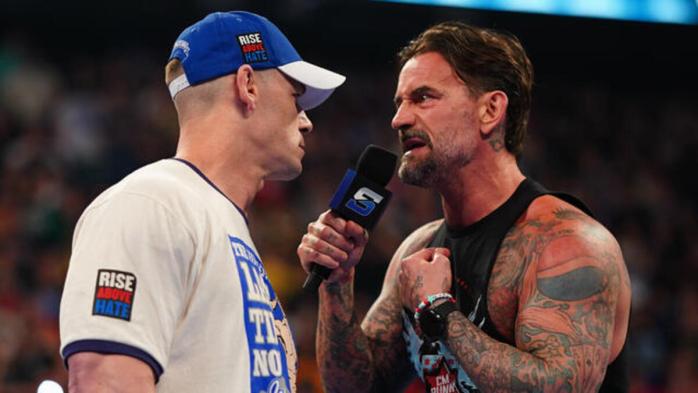

John Cena has reflected on the obsession that CM Punk maintained for years about headlining WrestleMania. The 17-time WWE world champion considers that his former rival ended up turning that goal into an unnecessary burden, to the point of initially describing that mindset as a weakness.
During a recent interview on Busted Open Radio, Cena addressed the pressure that wrestlers experience when trying to reach certain positions within WWE. Although he used Punk as an example, he made it clear that his comments were not meant to discredit him, but to explain why he considers it harmful to link professional success to a specific recognition.
The conversation began with a reflection on Cody Rhodes and the responsibilities that come with being considered the QB1 of WWE, an expression used to identify the company's top figure.
Cena took advantage of that context to recall the importance CM Punk placed on closing WrestleMania for much of his career, an aspiration that became one of his best-known personal goals.
My affection for Punk and his obsession with headlining WrestleMania... I think it has been a weakness.
The former world champion immediately clarified his words, explaining that he holds Punk in high personal regard and has observed a positive evolution in his attitude over the past few years.
If you talk to him now, he's evolving as a human being every time I see him. He's evolving as a man.
Cena believes the issue was not Punk's ambition, but the importance he had ended up giving to a goal that did not solely depend on him.
After initially using the word "weakness," Cena reconsidered his description and explained that he preferred to speak of an unnecessary burden.
In his opinion, wrestlers already face enough professional demands without adding the personal obligation to become world champions, top stars of the company, or headliners of WrestleMania.
It's just a personal preference of mine. I think he's carrying a burden he doesn't need. It's not a weakness. I think he's carrying a burden he doesn't need.
The veteran wrestler extended his reflection to Cody Rhodes, pointing out that striving for a specific position within WWE can become a distraction from a professional's true work.
Regarding Cody and his desire to become that figure, you're carrying a burden you don't need. Just do a great job and people will come.
For Cena, the priority should be to deliver the best possible performance and connect with the fans, without making recognitions or the company's creative decisions the main measure of personal success.
To explain his stance, Cena made a comparison with strength training, a discipline that has been part of his life for decades.
The wrestler pointed out that wrestling professionals already endure considerable pressure from physical demands, public expectations, and the need to maintain a high level of performance.
You're adding weight to the bar that you don't need to put there. The bar is already heavy enough. That's the point. We have to go out and perform.
With this analogy, Cena wanted to convey that obsessively pursuing certain achievements can hinder a career that is already demanding enough.
His argument does not mean giving up on big aspirations, but rather avoiding letting a specific goal condition a wrestler's personal satisfaction.
Another central point of the interview was the fleeting nature of success in professional wrestling.
Cena recalled that even wrestlers who have headlined some of the industry's most important periods only held the top spot for relatively short periods.
You only own it for a few seconds. Although I've been in this business for 23 years, I had it for a few seconds.
To illustrate this, he mentioned the cases of Steve Austin and Hulk Hogan, two key figures in WWE's expansion and popularity.
Cena placed Austin's main years of prominence between 1996 and 2001, while he highlighted the period from 1983 to 1988 as one of Hogan's most representative dominance stages, in addition to his later return to the spotlight.
The wrestler described those periods as «grains of sand on the beach of wrestling's existence», emphasizing that no star can stay at the top indefinitely.
From his perspective, this reality shows that turning a temporary position into the main goal of a career can lead to unnecessary frustrations.
 ES
ES
 US
US


